
Wedding Budget Breakdown by Percentage: The 50/30/20 Rule
The most common question couples ask is “how should we split our budget?” The answer isn’t one-size-fits-all, but there’s a simple framework that works as a starting point — then you adjust based on what actually matters to you.
1 January 2026 · 8 min read · Last reviewed April 2026
Key takeaways
- Venue and catering consume 35–50% of the average budget — your single largest category by a significant margin.
- The Australian median wedding costs $36,000 AUD; couples in Melbourne and Sydney typically spend 10–20% more.
- Every additional guest adds $150–$400 to your total — guest count is the most powerful budget variable you control.
- Allocate 5–10% as contingency before you start booking; something always costs more than the initial quote.
- Photography and video (10–15%) are the only things from your wedding day that last forever — avoid cutting here first.
The 50/30/20 rule for weddings
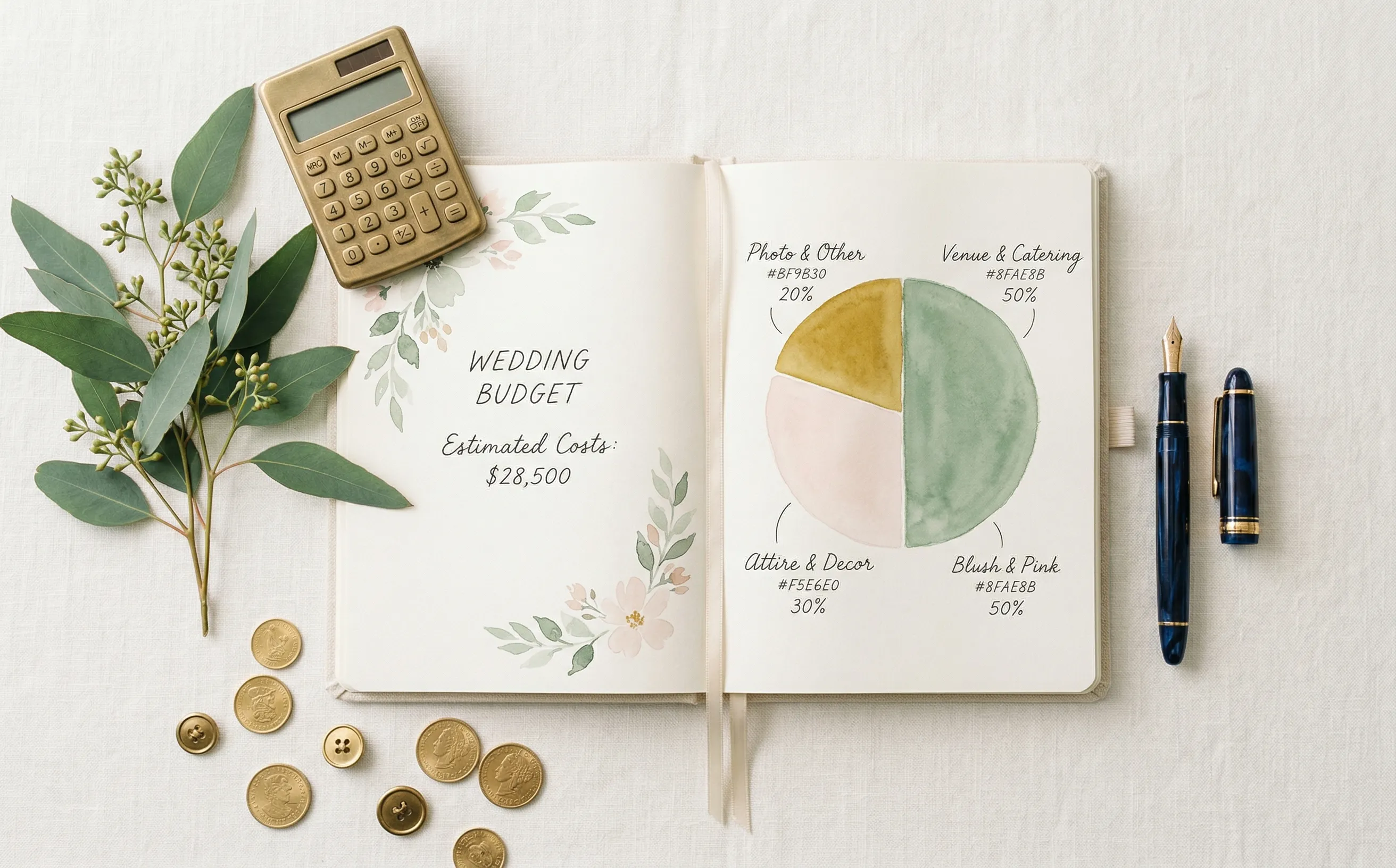
Borrowed from personal finance, the 50/30/20 rule adapts surprisingly well to wedding budgets:
- 50% — The essentials. Venue, catering, and drinks. This is non-negotiable — your guests need somewhere to be and something to eat and drink.
- 30% — The experience. Photography, entertainment, flowers, décor, and everything that makes the day feel like your day.
- 20% — Everything else. Attire, stationery, transport, rings, celebrant, and a contingency buffer for the unexpected.
This isn’t a rigid formula — it’s a gut check. If your venue and catering quotes are eating 65% of your budget, something needs to change: either the venue, the guest count, or the total budget.
Full category breakdown
Here’s how a typical wedding budget splits across all major categories. These percentages are based on industry data from The Knot’s annual survey and regional data from Easy Weddings (Australia).
Your single biggest line item. Includes venue hire, food, drinks, staffing, and service charges.
The only thing that lasts forever. Budget for both if you can — you won't regret it.
Dress or suit, alterations, shoes, accessories, hair, and makeup.
Centrepieces, bouquets, arch, buttonholes, table styling. Seasonal flowers save significantly.
Band, DJ, sound system, lighting. Live music costs 2–3× more than a DJ.
Save-the-dates, invites, menus, programs, signage. Digital cuts this to near zero.
Bridal car, guest shuttles, parking coordination.
Wedding bands — separate from the engagement ring.
Marriage licence, celebrant fees, ceremony permits.
Your safety net. Something will cost more than expected.
Want to see these percentages applied to your actual budget? Our free budget calculator does the maths automatically — enter your total budget, guest count, and priorities, and it generates a personalised breakdown.
How it varies by country
The proportional split is similar worldwide, but the absolute numbers change dramatically. Here’s how average wedding budgets compare across the five countries Ivory Lane supports:
| Country | Average | Venue % | Photo % | Attire % |
|---|---|---|---|---|
| Australia | $36,000 AUD | 42% | 12% | 8% |
| United Kingdom | £20,700 GBP | 38% | 11% | 9% |
| United States | $35,000 USD | 40% | 13% | 7% |
| Canada | $34,000 CAD | 41% | 12% | 8% |
| New Zealand | $32,000 NZD | 40% | 12% | 8% |
For a deeper dive into costs by country and category, read our guide on how much a wedding really costs or explore the Australian wedding cost breakdown with data by category and city.
When to break the rules
Percentages are a starting point, not a ceiling. Break them intentionally:
- Food is your love language? Push venue & catering to 55% and cut stationery to digital.
- Photography matters most? Allocate 15–18% and book an all-day package with a second shooter.
- DIY décor? Drop flowers to 3% and put the savings toward entertainment or the honeymoon.
- Small wedding, big party? With fewer guests, your per-head budget goes up — spend more on quality, less on quantity.
The key is being intentional. Pick 2–3 priorities and let them take a bigger share. Everything else gets a reasonable allocation. Read our step-by-step guide on how to create a wedding budget that works for the full framework.
The hidden 10%
The percentages above add to ~95%. The missing 5–10% is the stuff nobody tells you about:
- Service charges — many venues add 10–20% on top of quoted prices
- Tips — expected in the US and Canada ($1,000–$3,000 total)
- Dress alterations — $300–$800 on top of the dress price
- Wedding insurance — $200–$500, increasingly standard
- Post-wedding costs — thank-you cards, album printing, dress preservation, name changes
Our hidden costs calculator walks through 23+ commonly forgotten expenses and gives you a personalised estimate for your country.
Guest count changes everything
Every guest adds $150–$400+ in catering, drinks, table settings, stationery, and favours. Cutting 20 guests saves more money than cutting any single vendor category.
This is why the budget calculatorasks for guest count first — it’s the variable that moves every other number. If your budget feels tight, look at the guest list before slashing the photography or entertainment budgets.
Track it as you go
A budget breakdown is only useful if you update it. As you get real quotes, pay deposits, and make decisions, your percentages will shift. What matters is catching the drift early.
You can track this in a spreadsheet or use Ivory Lane’s budget tracker, which handles categories, vendor payments, and forecasting automatically — and syncs with your partner in real time.
Sources
- The Knot — Real Weddings Study 2025
- Easy Weddings — Australian Wedding Cost Report
- Hitched — UK Average Wedding Cost
Frequently asked questions
What percentage of your wedding budget should go to the venue?
Venue and catering combined typically take 35–50% of the total wedding budget. If you're using a venue with in-house catering, expect this single line item to consume the largest share. If your venue quote is pushing past 55%, something needs to change — either the venue, guest count, or overall budget.
What is the 50/30/20 rule for wedding budgets?
The 50/30/20 rule allocates 50% to essentials (venue, catering, drinks), 30% to the experience (photography, entertainment, flowers, décor), and 20% to everything else (attire, stationery, transport, rings, celebrant, contingency). It's a useful starting framework — not a rigid rule. Adjust the splits based on your actual priorities.
How much should I spend on wedding photography?
The industry benchmark is 10–15% of your total wedding budget. On a $30,000 budget, that's $3,000–$4,500. Photography is widely considered the category worth protecting — your photos and video are the only lasting record of the day. Many couples who cut here regret it; few who spent on photography do.
What is the average wedding cost in Australia?
According to the Easy Weddings annual survey, the median Australian wedding costs approximately $36,000 AUD. Couples in Melbourne and Sydney typically spend 10–20% more due to higher venue and vendor rates. Regional weddings and off-peak dates can come in well below this figure with careful planning.
How do you divide a $30,000 wedding budget?
Using the 50/30/20 framework: $15,000 for venue and catering, $9,000 for photography/entertainment/florals, and $6,000 for attire, transport, rings, celebrant, and a 5–10% contingency. The exact split shifts based on your guest count (higher count increases the catering share) and your top 2–3 priorities.
Ivory Lane Editorial
The Ivory Lane editorial team covers wedding planning, budgeting, and vendor advice for Australian couples. Our content is reviewed for accuracy against current AU industry pricing and updated regularly.