Wedding Day Timeline: Hour-by-Hour Guide
Your wedding day moves fast. A good timeline keeps everyone — vendors, bridal party, and you — in sync so nothing gets rushed and nothing gets missed.
9 April 2026 · 9 min read · Last reviewed April 2026
Key takeaways
- A 2:00 PM ceremony is the most common start time in Australia, with bridal prep typically beginning at 8:00 AM.
- Hair and makeup almost always runs over time — budget an extra 30 minutes per person beyond what your artist quotes.
- A first look (seeing each other before the ceremony) adds 60–90 minutes of photo time and reduces cocktail hour pressure.
- Family formal photos are the most time-sensitive block — have a pre-prepared shot list and a delegated person to round people up.
- Send the full timeline to every vendor and your MC at least two weeks before the wedding.
How to use this timeline
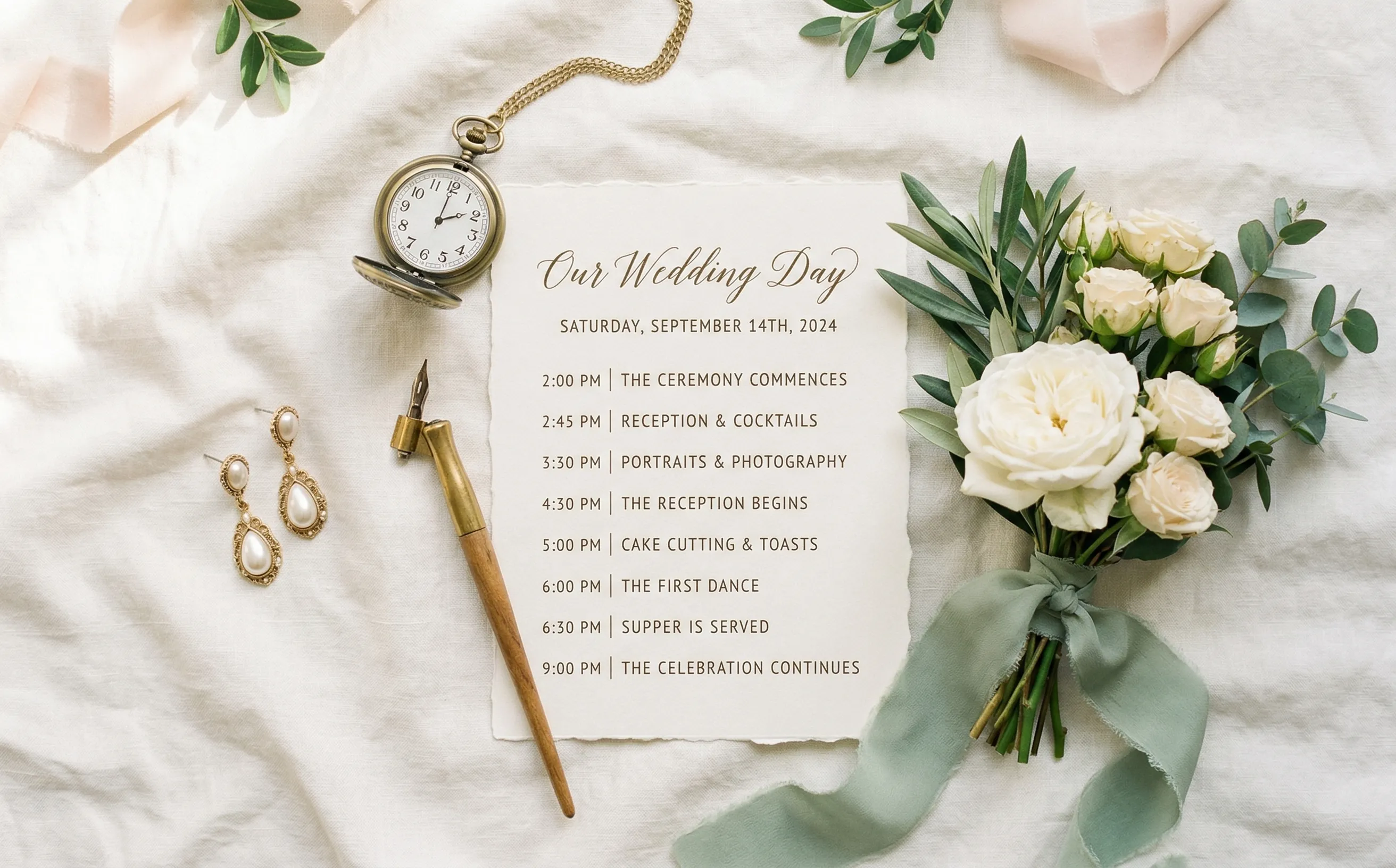
The sample below is for a 2:00 PM ceremony — the most common start time. Shift everything earlier or later to match your ceremony time. The relative gaps between events stay the same.
Want a timeline tailored to your exact start time and ceremony type? Our timeline builder tool generates one automatically — just pick your ceremony time and style.
Sample timeline: 2:00 PM ceremony
Hair and makeup begins
Start with bridesmaids so the bride is last (freshest look). Have breakfast delivered.
Bridal partyPhotographer arrives
Getting-ready shots, detail photos (dress, shoes, rings, invitations).
Bride's locationGroomsmen get ready
Suits, buttonholes, gift exchanges. Photographer splits time or a second shooter covers.
Groom's locationFirst look (optional)
Private moment before the ceremony. Saves time on couple portraits later.
BothPre-ceremony portraits
If doing a first look, knock out bridal party and couple shots before guests arrive.
Couple + bridal partyGuests arrive
Ushers seat guests. Music plays. Aim for 30 min buffer before ceremony.
Ceremony venueCeremony begins
Processional, vows, readings, ring exchange. Typically 20–40 minutes.
EveryoneCeremony ends
Recessional, signing of register or licence, confetti/petals moment.
EveryoneFamily formal photos
Have a shot list prepared — this is the most time-sensitive photo block.
Immediate familiesCocktail hour begins
Canapés, drinks, lawn games. This keeps guests happy while you do photos.
GuestsCouple + bridal party photos
Golden hour isn't always possible — work with your photographer on timing.
CoupleGuests move to reception
MC or venue coordinator directs guests to their seats.
EveryoneGrand entrance + first dance
Some couples prefer first dance after dinner — either works.
CoupleEntrée served
Speeches can happen between courses or after the main — plan with your MC.
EveryoneSpeeches begin
Keep to 3–5 speakers, 3–5 minutes each. Brief your MC on time limits.
Selected speakersMain course served
If doing a seated dinner, this is the main event. Buffets are more flexible.
EveryoneCake cutting
Quick moment — cake is served with dessert or as a late-night snack.
CoupleDance floor opens
Band or DJ kicks off. Parent dances can happen here if not done earlier.
EveryoneBouquet toss / garter (optional)
Increasingly optional — do it if it suits your vibe, skip it if not.
GuestsLast dance + send-off
Sparklers, lanterns, or a simple walk-out. Venue curfew usually dictates timing.
EveryoneAdjusting for different ceremony times
The key constraint is daylight for photos. Work backwards from sunset:
- Morning ceremony (10–11 AM) — Bridal prep starts at 6–7 AM. Reception lunch. Finished by late afternoon. Great for summer when sunsets are late.
- Afternoon ceremony (2–3 PM) — The classic. Cocktail hour bridges ceremony to dinner. Works year-round.
- Late afternoon (4–5 PM) — Photos in golden hour right after ceremony. Reception dinner. Best for autumn/winter when light fades early.
- Evening ceremony (6+ PM) — Dramatic lighting, candles, moody photos. All portraits happen before the ceremony or with flash.
First look: yes or no?
A first look (seeing each other privately before the ceremony) isn’t traditional, but it’s increasingly popular — and it has real timeline benefits:
- Pro: Knocks out couple portraits before the ceremony, freeing up cocktail hour
- Pro: Reduces nerves — you’ve already had your private moment
- Pro: Adds 60–90 minutes to your photo time
- Con: Some couples want the aisle reveal to be the first time they see each other
Neither choice is wrong. If you skip the first look, schedule 30–45 minutes of couple portraits during cocktail hour and do bridal party photos before the ceremony.
Time blocks that always get squeezed
These are the parts of the day that run over if you’re not careful:
- Hair and makeup — Always takes longer than quoted. Add 30 min buffer per person.
- Family formals — Rounding up family members is herding cats. Have a pre-made shot list and an assertive photographer.
- Speeches — Set a 5-minute limit and brief your MC. One speaker running long cascades through the whole evening.
- Travel between venues — If your ceremony and reception are in different locations, add 30–45 min minimum for transport, parking, and regrouping.
Who needs the timeline?
Your timeline should go to:
- Every vendor — photographer, videographer, florist, caterer, DJ/band, celebrant, transport
- Your MC or coordinator — they run the reception, they need the full picture
- Your bridal party — at least the key times (arrival, photos, ceremony)
- Parents — so they know when family formals happen
Don’t send the full timeline to all guests — they just need the ceremony time and reception location.
Build your own timeline
Use our free timeline builderto generate a personalised schedule based on your ceremony time, style, and whether you’re doing a first look. Download it as PDF and share with your vendors.
For the full planning picture, pair this with our wedding planning checklist — it covers everything from 12 months out to the week before.
Frequently asked questions
What time should a wedding ceremony start?
2:00–3:00 PM is the most popular ceremony time for Australian weddings. It allows morning prep, a natural transition into evening reception, and flexible photo timing. Late afternoon (4:00–5:00 PM) works well for autumn and winter when golden hour arrives earlier.
How long does a wedding ceremony typically last?
A civil ceremony with a celebrant typically runs 20–30 minutes. Religious ceremonies are usually 45–60 minutes or longer. Factor in the processional and recessional when scheduling vendor arrivals and the cocktail hour start time.
How long does hair and makeup take for a wedding?
Professional wedding hair and makeup takes 45–75 minutes per person. For a bridal party of 5 (including the bride), allow 5–6 hours total. Start with bridesmaids and finish with the bride so her look is the freshest. Always add a 30-minute buffer to your artist's quoted time.
What is a first look at a wedding?
A first look is a private moment before the ceremony where the couple sees each other for the first time on the day, photographed by the photographer. It allows couple portraits and bridal party photos to be done before the ceremony, adds 60–90 minutes of photo time, and is increasingly popular in Australia.
How long should wedding speeches be?
Each speech should run 3–5 minutes. With 4 speakers (celebrant introduction, parents, best man, maid of honour), the full speech block runs 15–25 minutes. Brief every speaker in advance on the time limit and have your MC enforce it — one long speech cascades through the whole evening.
Ivory Lane Editorial
The Ivory Lane editorial team covers wedding planning, budgeting, and vendor advice for Australian couples. Our content is reviewed for accuracy against current AU industry pricing and updated regularly.